 RProvider
Developer notes
Binding to R's native C API is not entirely stable and so we do not want to crash the F# compiler (or Visual Studio / Ionide / FSAC) when something goes wrong with R. For this reason, we run the type discovery in a separate process and communicate with it via .NET pipes.
Project structure
To account for the single-threaded nature of R, we use the following structure.
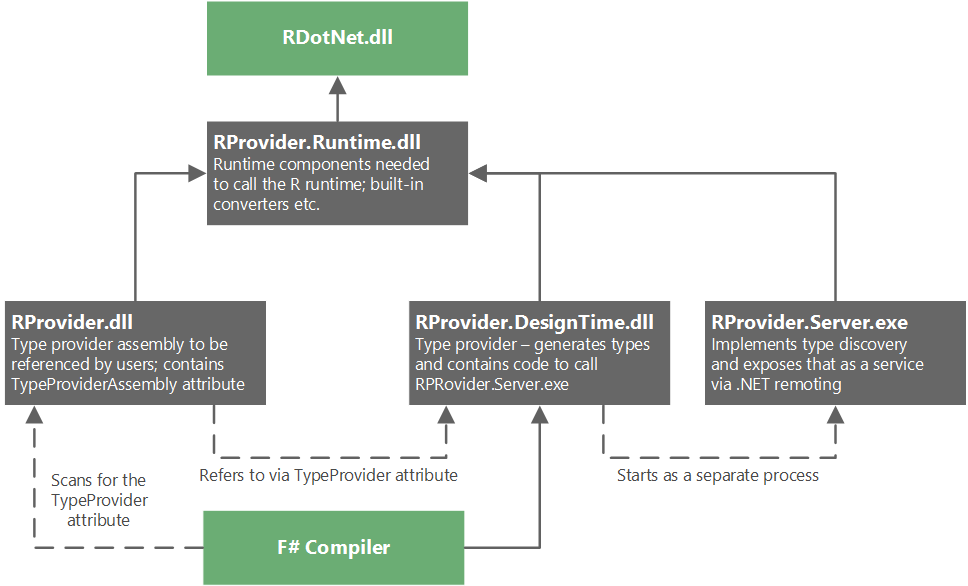
The individual assemblies are as follows:
-
RProvider.Abstractions. Contains user-facing root erasable types that are referenced by both the design-time and runtime parts of the type provider.
-
RProvider.dll- this is runtime assembly. Contains runtime functionality (such as initialization of R, interop with R and converters that convert values between F# and R). It also contains helpers (logging, etc.). This is the assembly that the user of R provider will reference. It contains theTypeProviderAssemblyattribute pointing to the assembly with the actual type provider code.
-
RProvider.DesignTime.dll- this is where the type provider code lives. This generates types by calling theRProvider.Serverexecutable to do the type discovery.
-
RProvider.Server- this is started as a stand-alone process that performs type and package discovery in R. It is called by the DesignTime component and restarted automatically. This also needs to setup theAssemblyResolveevent handler. It is compiled as platform- and architecture-specific executables, so an exe on windows for example.